

Players of string instruments make up a sizable proportion of any orchestra, and most of these instruments fall into four categories: violins, violas, cellos, and double basses. All four have a similar shape, made from a curvy wooden body with strings stretched across the top and up the neck of the instrument. The strings are most commonly made from steel or nylon, and they’re played using the fingers or a bow, a piece of wood with horse hairs stretched from one end to the other. The strings are tuned using pegs that can be turned to tighten or loosen them. All of these parts come together to give an orchestra its distinctive sound, producing music that draws thousands of people to fill the seats of amphitheaters all over the world.

Orchestral Members of the String Family
Violin
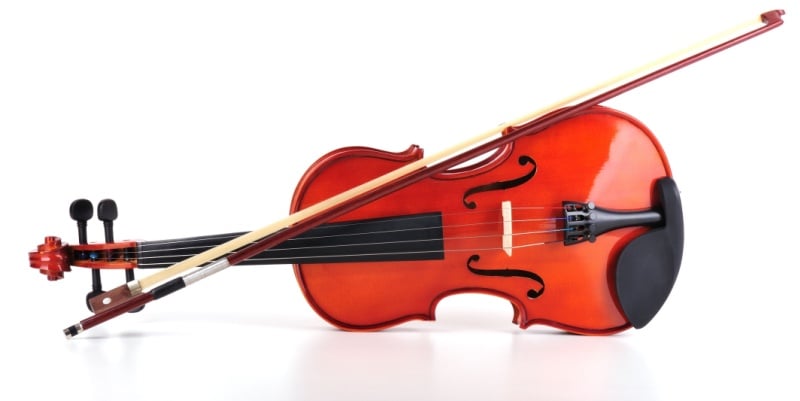
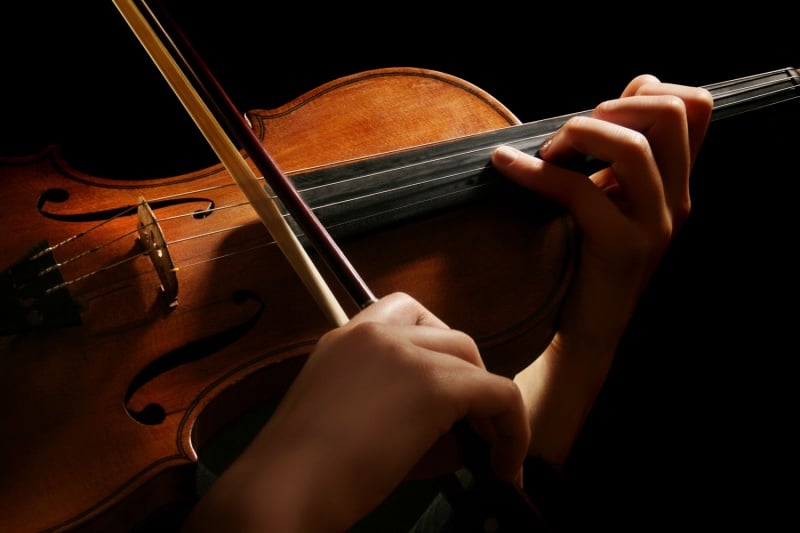
Violins are the smallest string instruments in an orchestra and produce the highest-pitched sounds. Sheet music for violins is written using the treble clef. There are usually more violins in an orchestra than any other instrument, and they’re most commonly divided into two sections; the first violins will carry the melody, while the second violins harmonize with them. Violins are held on the shoulder and beneath the chin when they are played, with the other end being held by the player’s left hand. A full-size violin is about two feet long, but small sizes are also made to fit smaller players.
Viola
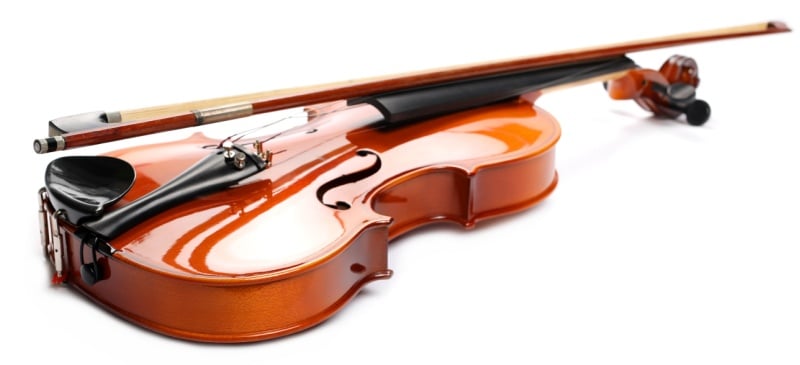
Violas are a little bigger than violins and use thicker strings that make lower, warmer sounds than those of a violin. Viola players almost always play harmony parts, and they hold and play their instruments the same way that violin players do. However, the sheet music they play is different; the viola is one of the few instruments for which music is written using the alto clef.
Cello
Cellos have the same shape as a violin or viola, but they’re much larger, too large to be held on a person’s shoulder. Instead, they’re played upright. At the end of the body of a cello is a metal peg that rests on the ground to support the instrument, which is held between the seated player’s knees with the neck resting on the player’s left shoulder. Cellos are lower-pitched instruments than violas, and their sheet music is written using the bass clef.

Double Bass
The double bass is the largest common string instrument, typically measuring more than 6 feet in length. It’s played upright like a cello, but it’s so large that the player has to stand up to hold and play it. The double bass is also the lowest-pitched string instrument, and players read sheet music written using the bass clef.

Harp
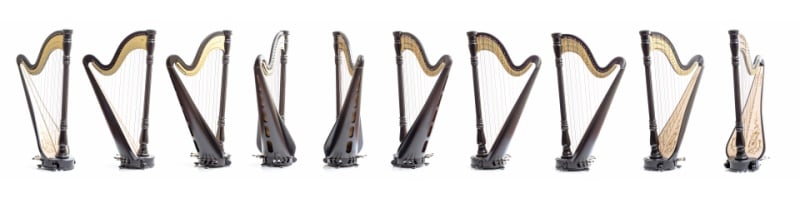
Harps are quite different from most other string instruments, both in shape and in how they are played. The harp is a tall instrument shaped somewhat like a triangle, with a vertical part on one side and a sloped part that leans against the player’s right shoulder. While violins, violas, and cellos have four strings and basses have four or five strings, the harp has 47, which are strung from the sloped piece to the top piece of the harp and all have different lengths. Each string corresponds to a natural note, and they’re played by being plucked, not with a bow. Foot pedals at the bottom of the harp allow the player to alter the pitch of the strings to create sharps and flats. Sheet music for harps is written on both the treble and bass clefs.
How String Instruments Work
Most string instruments sounds the way they do due to a combination of three things: the vibrations of the strings, the resonance of the instrument’s body, and the technique of the player.
The Strings
Making the strings of a string instrument vibrate produces sound waves that carry notes to the listeners’ ears. The pitch of a string can be altered by changing three factors: the string’s length, thickness, or tightness. A string that is longer, thicker, or more loosely strung will vibrate more slowly, producing a lower tone, while a shorter, thinner, or tighter string will vibrate faster, making a higher pitch.

The Sound Box
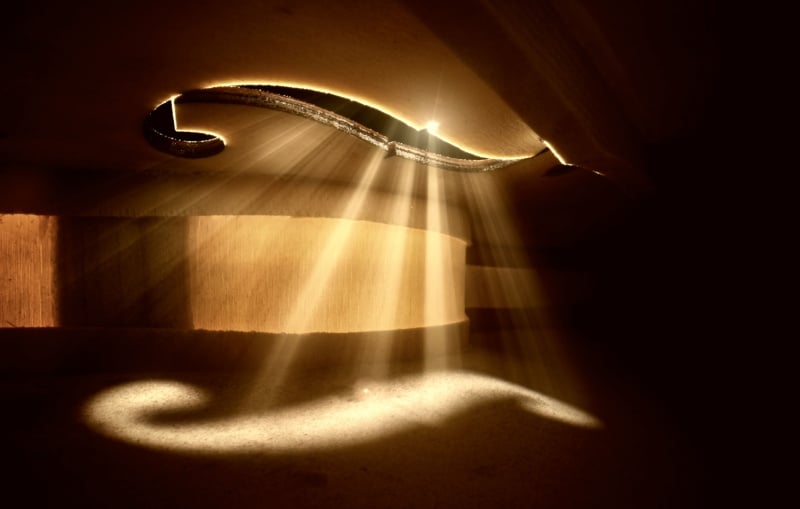
Most string instruments have a hollow body that helps to amplify the sounds of the vibrating strings. This part of the instrument is called the sound box. When a string is played, the vibrations are picked up by the bridge of the instrument, which transfers the vibrations to the soundboard and the sound box. The air inside the sound box then vibrates, too, which makes the sound louder.
Technique
Strings can be played by plucking them with the fingers, rubbing a bow against them, or striking them. Each method makes a different type of sound; plucked or struck strings sound shorter and more distinct, while strings played with a bow produce a smoother sound. Players of most string instruments also use the fingers of their other hand to press down on the strings, which makes them shorter, changing the notes that are produced. In this way, just a few strings can be used to produce dozens of different notes.
Learn More About String Instruments
-
-
- The String Family of Orchestra Instruments
- Parts of a String Instrument Explained
- Meet the String Family
- How to Take Care of a Violin, Viola, or Cello
- Six Bowed String Instruments You’ve Never Heard Of
- The Development of String Instruments
- Is the Piano a Percussion or String Instrument?
- Instruments of the Orchestra
- How Strings Are Made
- Theater Sectionals
- Origins of String Instruments
- The Story of the Bow
- Curved Theater Seating
- The Science of String Instruments
- Seats for Performance Spaces
- String Playing Techniques and Terms
- How the Violin Got its Shape
- Home Theater Seating
- Secrets of the Stradivari Violin
- A Beginner Guide to Changing Your Strings
-